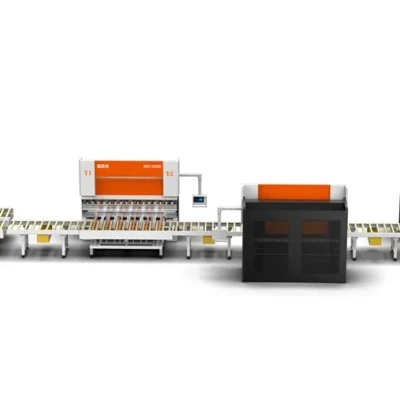
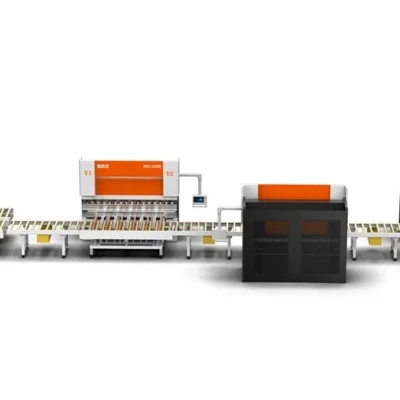
Structural Characteristics of Core Units
Material Assembly Unit: The entire process-including feeding, handling, quality inspection, and discharge-is unmanned; robotic arms perform assembly tasks, with stable control achieved via PLC programming.
Machining Unit:Utilizes multi-axis CNC machining centers with automatic adjustment of parameters such as feed and cutting rates; flexible fixtures accommodate high-mix, low-volume production.
Surface Treatment Unit: Automated spraying/brushing equipment ensures uniform processing; sensors monitor thickness and quality in real-time, while parameters like temperature and application speed are automatically regulated.
Quality Inspection Unit: Integrates CCD visual inspection, dimensional measurement, and tensile testing; the inspection process is fully automated, with results uploaded to the enterprise management system in real-time.
Structural Characteristics of Operational Workflows
Serial Structure:Execution units operate sequentially-the subsequent step begins only after the preceding one finishes; the control logic is simple, making it suitable for straightforward process flows.
Parallel Structure: Multiple execution units operate synchronously without mutual interference, resulting in high efficiency; suitable for complex processes, though precise synchronization and coordination between units are critical.
Cyclic Structure: Specified operations are repeated according to fixed logic, meeting the needs for the repetitive production of large volumes of identical products.
Selective Structure:Automatically switches between different execution paths based on input conditions; suitable for flexible production scenarios involving diverse requirements and product varieties.